Instagram advertising has become essential for businesses wanting to grow online. Every day, thousands of brands compete for attention, but only a few see real returns from their Instagram ads. The difference between wasting money and generating sales comes down to strategy, not budget size.
If you’re new to running Instagram ads, this guide shares ten practical strategies that deliver results. No fluff. No outdated tactics. Just approaches that work right now for beginners who want their Instagram ads to convert.
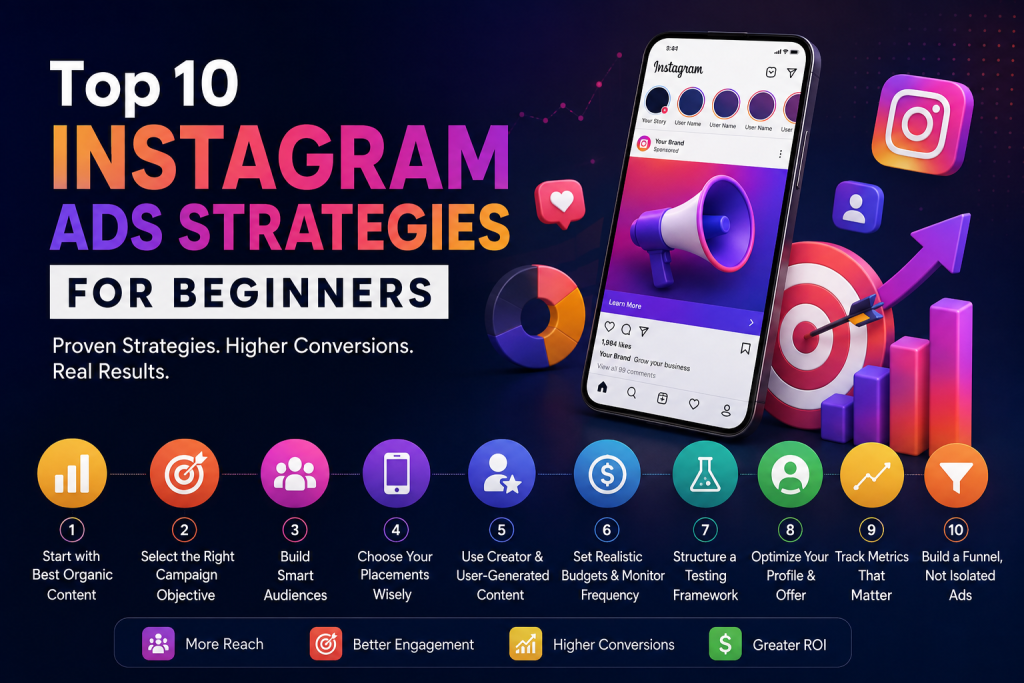
1. Start with Your Best Organic Content
Before creating fresh content for Instagram ads, look at what your audience already loves. Posts that naturally generate engagement are your golden tickets for advertising.
This approach works because the algorithm has validated this content. When you put money behind proven posts, you amplify a message that clearly resonates rather than gambling on untested creative.
How to implement this:
- Open Instagram Insights and review your last 90 days of content
- Find posts with above-average saves and shares
- Boost these posts directly from your profile or create new ads using this creative
Many beginners create entirely new content just for their campaigns. While custom creative has its place, starting with proven organic content reduces risk and gives you benchmarks for what works.
2. Select the Right Campaign Objective
Instagram offers multiple campaign objectives, and choosing the wrong one is a common beginner error. Each objective tells the algorithm what you want.
The breakdown:
- Awareness: Use this when you want maximum visibility. Perfect for new businesses or product launches.
- Traffic: Choose this when you want people to visit your website or landing page.
- Engagement: Select this to get more likes, comments, and shares.
- Leads: Use this to collect email addresses or contact information.
- Sales: This is your conversion-focused objective for driving purchases.
The key is honesty. If you select “Engagement” but actually want sales, you’ll get interactions without revenue. Match your objective to your actual goal.
3. Build Smart Audiences
Instagram targeting is powerful, but beginners often target too broadly. Reaching millions sounds impressive but usually means wasted spend.
Start with warm audiences:
These are people who already know you. Create custom audiences from:
- Website visitors (install the Meta Pixel)
- Email subscribers
- Past customers
- People who engaged with your content
Then expand with lookalikes:
Once you have a solid custom audience, create a 1% lookalike. This gives you the closest match to existing customers.
One brand combined lookalike and interest-based targeting, achieving an 8.2x return on ad spend in three weeks.
The rule: Start narrow and expand gradually. It’s easier to scale a winning audience than fix a broad one.
4. Choose Your Placements Wisely
Instagram ads appear in multiple placements, each serving a different purpose.
Primary placements:
- Feed ads: Appear in the main scroll. Work well for nearly every objective.
- Reels ads: Excellent for awareness and engagement. Short videos work best.
- Stories ads: Full-screen and immersive. Great for time-sensitive offers.
- Carousel ads: Allow multiple images or videos. Perfect for showcasing features.
For beginners, automatic placements often work best initially. The algorithm tests different positions and optimizes toward what performs.
5. Use Creator and User-Generated Content
People trust people more than brands. Ads featuring real customers or creators consistently outperform polished, branded creative.
Why this works:
- Authenticity builds immediate trust
- User-generated content reduces ad fatigue
- Real people feel less like advertising and more like recommendations
Getting started:
- Partner with micro-influencers who have engaged audiences
- Encourage customers to share experiences and ask permission to feature their content
- Consider whitelisting to run ads through creator profiles
One creator-led campaign delivered a 35% higher click-through rate and 95% lower cost-per-click compared to branded ads.
6. Set Realistic Budgets and Monitor Frequency
Budgeting for beginners:
You don’t need thousands to start. A daily budget of $10 to $20 is enough to test concepts. The first two weeks should focus on data collection, not profit.
Understanding frequency:
Frequency tells you how many times the same person has seen your ad. When frequency exceeds 2.5 to 3.0, you’re dealing with ad fatigue.
How to fix:
- Refresh creative regularly
- Exclude people who already converted
- Expand your audience size
If someone keeps seeing your ad without acting, they’re either not interested or the creative needs improvement.
7. Structure a Testing Framework
Successful ads come from systematic testing, not random guessing.
The simple approach:
- Test one variable at a time – creative, headline, or audience
- Run tests long enough to reach significance – usually 100 to 200 conversions
- Document everything – what worked, what didn’t, and why
What to test first:
- The offer (your biggest lever)
- The audience
- The creative
- The copy
Test headlines like “Double Your Income” against “Get 10 New Clients This Month.” Small changes can lead to different results.
8. Optimize Your Profile and Offer
Before spending money, ensure your profile is ready to convert.
Profile checklist:
- One clear bio stating who you help and what you offer
- One strategic link
- Three pinned posts demonstrating expertise
- Story highlights showcasing work and results
Your offer must be clear:
- One specific offer
- One target client
- One bold promise with a timeline
When everything is clear, cold traffic immediately understands what you offer.
9. Track Metrics That Matter
Vanity metrics don’t pay bills. Focus on numbers tied to business results.
Key metrics:
- Click-Through Rate: Healthy range is 0.5% to 1.5%
- Conversion Rate: Percentage of clicks becoming leads or customers
- Cost Per Conversion: Are you acquiring customers profitably?
- Return on Ad Spend: Revenue divided by spend
Essential setup:
- Install the Meta Pixel to track conversions
- Consider Conversions API for accurate data
- Use UTM parameters to track traffic
10. Build a Funnel, Not Isolated Ads
Single ads rarely convert cold audiences directly. Use a sequence that moves people from awareness to purchase.
The funnel structure:
- Top: Awareness ads introducing your brand
- Middle: Retargeting ads for people who engaged
- Bottom: Offer-based ads for warm audiences
Pro tip:
Use Manychat to automate responses when people DM you. Responding within 15 seconds increases conversion chances.
This approach delivered 5 to 6 times return on ad spend for one creator.
Your 8-Week Action Plan
Week 1-2: Identify best organic content and set up tracking. Launch first test campaign with small budget.
Week 3-4: Analyze data. Which creative worked? Which audience responded? Start A/B testing.
Week 5-6: Scale what works. Increase budgets on winning ads. Pause underperformers.
Week 7-8: Implement retargeting. Set up automated DM sequences.
Final Thoughts
Treat your first 30 days as a learning phase. You’re gathering data, not chasing viral results.
Instagram ads are not complicated once you understand the fundamentals. Start small, test systematically, learn from data, and scale what works. These strategies have helped countless beginners transform their campaigns from money-wasters into reliable revenue channels.